


Should we build it?
AI changed the pace of building. A feature scoped for a two-week sprint can now ship in an afternoon. What didn't change is how long it takes to decide what's worth building, and to know whether it worked.
Agile and Scrum were designed for a world where building was slow and expensive. Much of their friction was also where quality came from – where a designer caught the broken flow, and someone asked, "Should we build this at all?"
AfterAgile™ moves that structure into the system instead: a written Intent, a small team of Definers, sessions that document themselves, and a Dashboard everyone can see.
AI accelerates building. AfterAgile™ accelerates deciding.
No tickets. No backlog. No retros.
Why now
AfterAgile™ exists because two things are happening at once: the way we build software has changed, and the people who build it haven't been given a new way to work.
AI collapsed the cost of building. A feature scoped for a two-week sprint can ship in an afternoon.
The operating model didn't change with it. Most teams still run sprints, standups and backlogs designed for a world where building was slow and expensive.
The gap is landing on people. Some colleagues are out of work. Those still employed are being handed new roles with no playbook.
I'm writing this now because the window to help people through the shift is now, not after it settles.
Out of work, and not prepared
So many talented colleagues are out of work right now. Worse, many aren't prepared for the roles opening up on teams that build with AI.
These are experienced people: designers, product managers, engineers, QA leads with decades of craft.
The job descriptions changed faster than the training did. "Works with AI" now shows up in roles that never existed under Scrum.
No one handed them a model for what those teams look like day to day, who owns what, or how quality holds up at AI speed.
AfterAgile™ is meant to give them that model, so they can walk into an interview, or a new team, and speak the language of how the work is done now.
Still employed, in new roles
Anyone still employed is facing a new role, whether or not their title changed.
CX – Now at the center of the work: getting to the bottom of the customer need, and identifying the most pressing customer challenge each week.
UX – Was drawing screens and handing them off. Now the architects of the end-to-end experience, shaped through prompts, the design system and the customer journey.
Product – Was managing backlogs, writing tickets and negotiating story points. Now, for the first time since the role began, doing actual product work: answering "why?"
Engineering – Was writing most of the code. Now applying their problem-solving in an entirely new arena: architecture, the Engineering Guardrails, and the systems that keep AI on track.
Each shift is an opportunity, but only if people are shown what the new job is. Right now most are figuring it out alone, mid-flight.
My philosophy
Machines own execution. Humans own intent, care, and aesthetic.
We removed the friction that forced us to think. The handoffs and reviews were slow, but that was where quality came from. AfterAgile™ puts that judgment back on purpose.
Structure moves from the calendar into the system. Instead of sprints, standups and retros: a written Intent, Definers who test what they define, and sessions that document themselves.
People matter more, not less. The tools can build. Only people can decide what's worth building, and whether it's right for a customer on their worst day.
Back to the spirit of the original manifesto. Agile started as permission to talk to each other. AfterAgile™ brings the room back together: CX, Product, UX and Engineering building side by side in one IDE.
Customer signal drives the work. The cadence follows learning, not building. We measure what customers actually did, and that becomes next Monday's Intent.
The Week
Six steps, Monday to Friday. One team, one real customer challenge, one full cycle – days, not quarters. Every session is recorded, and AI turns it into decisions, intentions and actions.
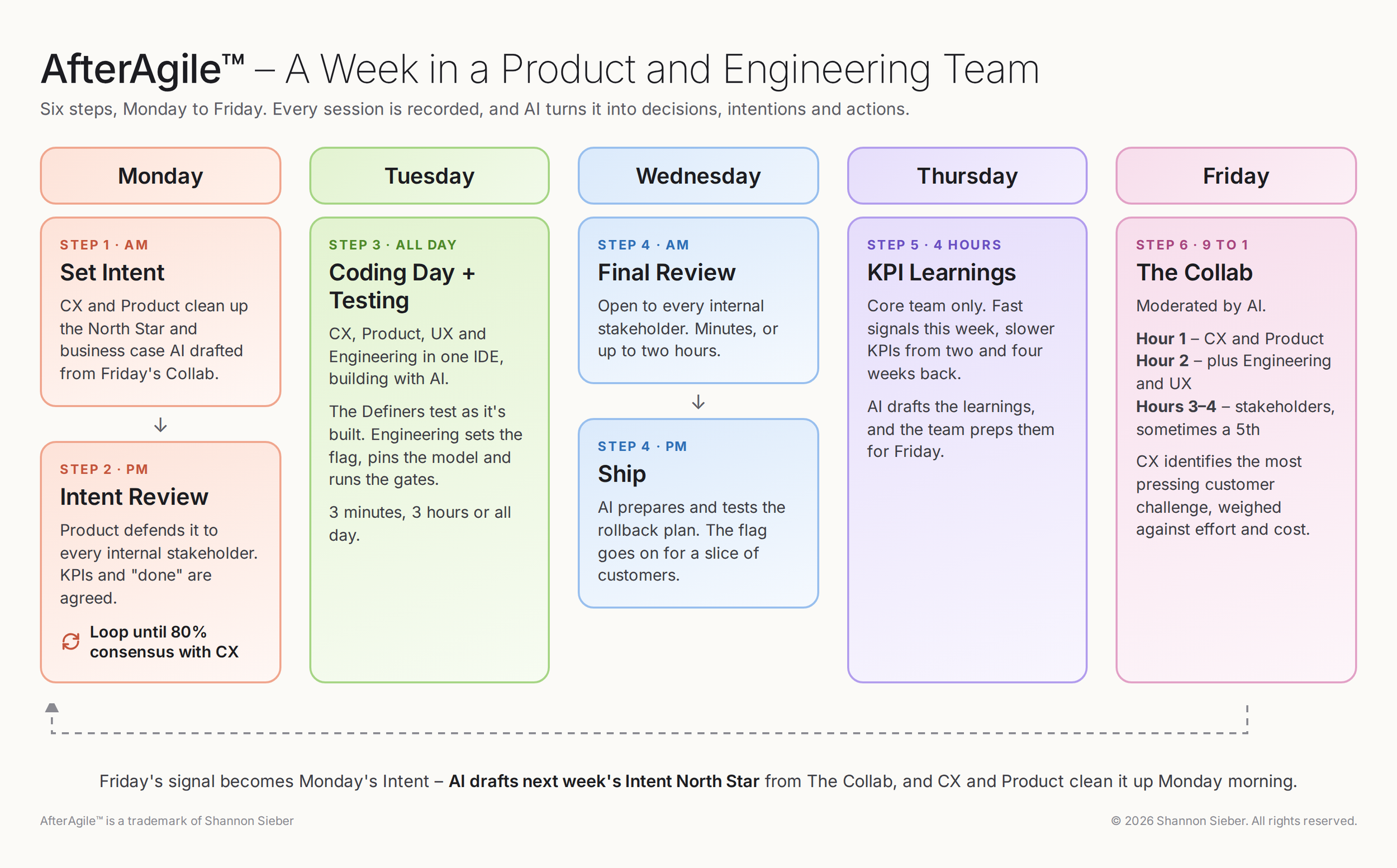
Six steps, one continuous cycle
Set Intent (Monday AM) – CX and Product clean up the North Star and business case AI drafted from Friday's Collab.
Intent Review (Monday PM) – Product defends it to every internal stakeholder: why now, what it does for customers, and how the business makes or saves money. KPIs and "done" are agreed. It repeats until 80% consensus with CX.
Coding Day + Testing (Tuesday) – CX, Product, UX and Engineering in one IDE, building with AI. The Definers test as it's built.
Ship (Wednesday) – Final Review in the morning. AI prepares and tests the rollback plan, and the flag goes on for a slice of customers.
KPI Learnings (Thursday) – Four hours, core team only. Fast signals from this week, behavior from two weeks back, outcomes from four weeks back.
The Collab (Friday) – Moderated by AI. CX identifies the most pressing customer challenge, weighed against effort and cost.
Friday's signal becomes Monday's Intent.
The Team
CX is customer-centric. The business is business-centric. Product translates.
Definers – CX, Product and UX. Whoever defines it, tests it. No middle man.
CX – The customer need: the what and the why. Leads The Collab, and leads on the customer as a whole.
Product – Why now, and what it's worth. Market viability and the business case.
UX – Brand, UI and workflow, and how it feels to use.
Engineering – Owns the Engineering Guardrails (architecture, data, model safety, security) and leads Crisis Mode.
Stakeholders – Internal only. They challenge the Intent at Intent Review and preview the work at Final Review.
AI – Drafts every artifact, moderates The Collab and writes the rollback plan. AI drafts, people decide.
Every session documents itself
No notes, no forms, no tickets. Every session is recorded, AI analyzes it into decisions, intentions and actions, every action gets a named owner, and the owner edits it live in the AI project. Then it's the record.
The Guardrails
Fast, but never around the gates.
Engineering Guardrails – The rules AI builds inside, enforced by the pipeline on every merge.
AI Safety – Pinned models, traceable prompts, and corrections fixed at the source.
One IDE – The whole team around one AI coding session on Coding Day.
When AI Gets It Wrong – Correct the source, not just the output, so it never happens twice.
Crisis Mode – Restore first, understand second, learn at The Collab.
Start with one team
Don't reorganize the company. Start with one team, one real customer challenge, and one week.
Sponsor – One leader who owns a customer outcome, and says yes.
Pilot – One real customer challenge. One full week, Monday to Friday.
Cut Over – For existing products, run both ways side by side, and move one product area at a time.
I offer AfterAgile™ pilot coaching with me and my team, from finding your sponsor to running your first full week.
Request the playbook
The full AfterAgile™ Playbook is 82 pages: the model, the week day by day, the team, the guardrails, the tools, and how to get started. It's shared under NDA.
Tell me a little about your team, and I'll be in touch.